


Andaman Sets two Guinness World Records
Syllabus: GS1/Places in News
Context
- The Andaman and Nicobar Islands created another Guinness World Record with the formation of the tallest human stack underwater at Swaraj Dweep, formerly known as Havelock Island.
About
- The feat comes a day after the Union Territory administration achieved a landmark by unfurling the world’s largest underwater national flag, measuring approximately 60 by 40 metres.
- Both the Guinness World Records are expected to draw national and international attention and will boost the profile of the Andaman and Nicobar Islands as a hub for scuba diving and eco-tourism.
Andaman and Nicobar Islands
- Location: The islands are located 1,300 km southeast of the Indian mainland in the Bay of Bengal.
- It extends from 6° 45′ N to 13° 41′ N and from 92° 12′ E to 93° 57′ E.
- This archipelago is composed of more than 500 big and small islands, which are divided into two distinct groups of islands – The Andaman Islands and the Nicobar Islands.
- Duncan Passage separates South Andaman from Little Andaman.
- Ten Degree Channel separates the Andaman Islands from the Nicobar Islands.
- Six Degree Channel separates the Nicobar Islands from Sumatra (Indonesia).
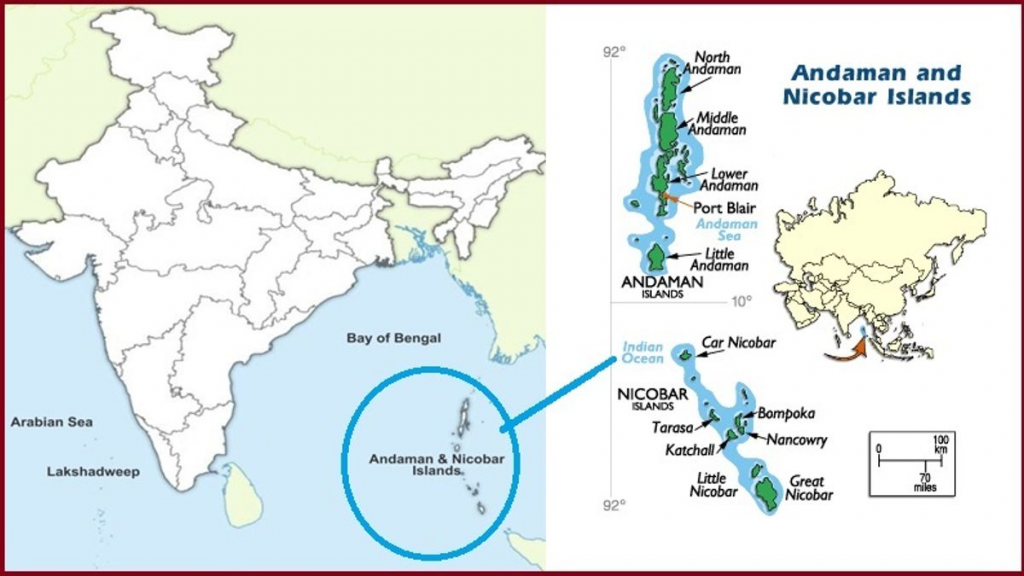
Facts Related to Andaman and Nicobar Islands
- The Southernmost Island is Great Nicobar whose southernmost tip is only 150 km away from Sumatra, Indonesia.
- The highest point is Saddle Peak in North Andaman (732 metre), Mount Thullier in Great Nicobar (642 metre).
- Pandunus or Nicobar Breadfruit is a rare fruit found in the Andaman and Nicobar islands.
- Barren Island of the Andaman & Nicobar Island group is the only active volcano not just in India but the whole of South Asia.
- Indira Point in Great Nicobar is the Southern-most point of India.
- Great Nicobar Biosphere Reserve declared in 1989 & recognised as UNESCO Man and Biosphere Reserve in 2013.
- The islands host one of the world’s last uncontacted tribes, the Sentinelese.
Source: TH
Lipulekh Pass
Syllabus: GS1/Geography
In News
- Nepal has objected to India’s plan to conduct the Kailash Mansarovar Yatra through the Lipulekh pass, which Nepal considers disputed territory.
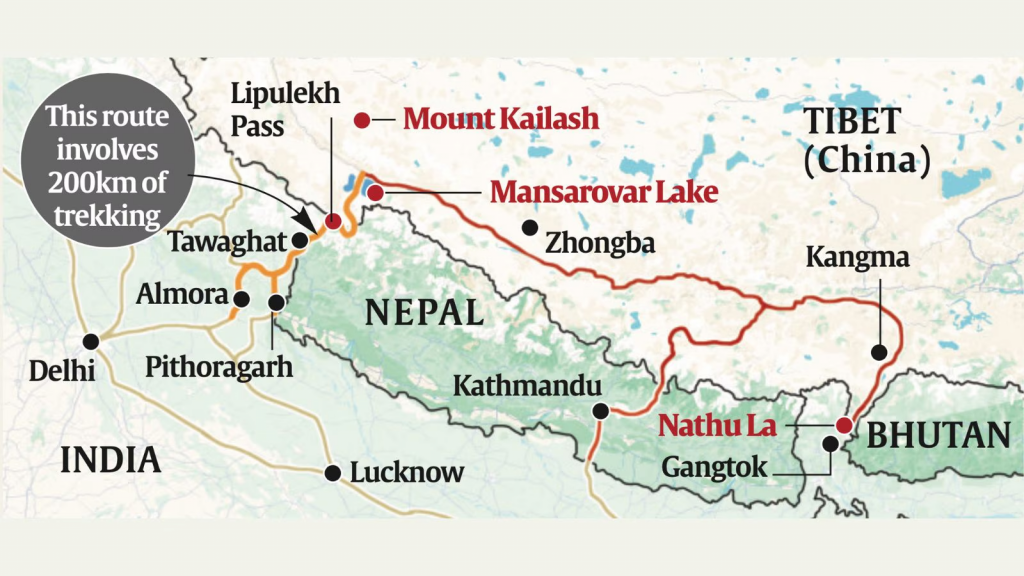
Lipulekh Pass
- It is a high-altitude Himalayan pass in Pithoragarh district, Uttarakhand (India).
- It is located at an elevation of about 5,334 metres in the Kumaon region.
- It serves as a strategic tri-junction connecting India, China (Tibet), and Nepal.
- It is accessed from India through Dharchula.
- It is strategically and culturally important as a traditional route for Indian pilgrims on the Kailash Mansarovar Yatra.
- It also has historical commercial value, as it became the first India–China border trade post when trade opened in 1992.
What is the Dispute?
- The tension between India and Nepal over the Lipulekh Pass is a complex boundary dispute rooted in the 1816 Treaty of Sugauli.
- The Treaty was signed between the British East India Company and the Kingdom of Nepal and established the Kali River (Mahakali) as Nepal’s western border.
- Nepal claims the river originates at Limpiyadhura, which would place the Lipulekh and Kalapani regions within its territory.
- Conversely, India maintains that the river begins at a lower point near Kalapani keeping the pass a strategic tri-junction between India, Nepal, and China within its state of Uttarakhand.
Source: TH
Apnoea Test
Syllabus: GS2/Health
Context
- The Supreme Court is examining the plea alleging apnoea test is inconclusive to assess brain death.
About
- The apnoea test is a critical component in the determination of brain death.
- It assesses whether the patient can initiate spontaneous breathing when carbon dioxide (CO₂) levels rise.
- It is conducted to confirm absence of respiratory drive from the brainstem (specifically the medulla), which is essential in diagnosing brain death.
- Normally, rising arterial CO₂ stimulates the respiratory centers in the brainstem to trigger breathing.
- If no breathing occurs despite elevated CO₂, it suggests loss of brainstem function.
- Brain death is the irreversible and complete loss of all functions of the brain, including the brainstem.
- A person who is brain dead has no consciousness, no brainstem reflexes, and no ability to breathe independently, and is legally considered dead in many countries, including India.
Source: TH
Cell Broadcast Alert System
Syllabus: GS2/Governance
In News
- India has launched the SACHET emergency alert system using indigenous cell broadcast technology to send instant disaster warnings.
Cell Broadcast
- It is a one-to-many mobile messaging system that sends short alerts to all phones in a specific geographic area at the same time.
- Unlike SMS, it does not target individual numbers, so it can deliver messages instantly even during network congestion.
- It was developed in the early 1990s by the European Telecommunications Standards Institute (ETSI) and first demonstrated in 1997 in Paris, it is now widely used in over 30 countries.
- Cell Broadcast is used to send fast, reliable emergency alerts to people in specific areas during disasters like earthquakes, floods, cyclones, storms, heatwaves, and industrial accidents such as gas leaks or chemical incidents.
- The primary objective is to shift India’s disaster management from a reactive to a proactive.
Advantages of cell broadcast system
- Cell Broadcast does not use personal data and does not require phone numbers, apps, or subscriptions.
- It delivers loud, attention-grabbing alerts that override normal phone activity, including silent or Do Not Disturb modes, and the message stays on screen until acknowledged.
- It is used very sparingly for life-threatening emergencies such as earthquakes, flash floods, landslides, dam breaks, and other major disasters, and is only sent to people in the affected area.
Source :IE
Fugitive Economic Offenders
Syllabus: GS2/ Governance
Context
- The Enforcement Directorate (ED) has declared 21 individuals as Fugitive Economic Offenders (FEOs).
What is a Fugitive Economic Offender (FEO)?
- Fugitives are individuals who are accused or convicted of a crime and deliberately evade the legal process by fleeing from the jurisdiction of the country where the offence was committed.
- They escape to avoid arrest, trial, conviction, or punishment by law enforcement authorities and their return requires a legally recognised international mechanism, known as extradition.
- Under the Fugitive Economic Offenders Act, 2018, they are defined as an individual against whom a court in India has issued an arrest warrant for a scheduled offence involving ₹100 crore or more.
Key Features of the Fugitive Economic Offenders Act, 2018
- Confiscation of Property: The Act empowers authorities to attach and confiscate properties of the offender located both in India and abroad.
- The law also covers benami properties and assets indirectly controlled by the offender.
- Bar on Civil Claims: The Act disallows declared FEOs from initiating or defending any civil claims in Indian courts.
- Special Court Mechanism: The Act provides for adjudication of cases through special courts established under the Prevention of Money Laundering Act, 2002.
Directorate of Enforcement (ED)
- Origin: It was established in 1956 with the formation of an ‘Enforcement Unit’ under the aegis of the Department of Economic Affairs and handles Exchange Control Laws violations under Foreign Exchange Regulation Act, 1947 (FERA 1947).
- It was renamed as the Enforcement Directorate in 1957, with administrative control later shifting to the Department of Revenue.
- It is a multi-disciplinary organization mandated with investigation of the offence of money laundering and violations of foreign exchange laws.
- The statutory functions of the Directorate include enforcement of following Acts:
- The Prevention of Money Laundering Act, 2002 (PMLA),
- The Foreign Exchange Management Act, 1999 (FEMA),
- The Fugitive Economic Offenders Act, 2018 (FEOA).
Source: IE
UPI Completes 10 Glorious Years
Syllabus: GS3/ Economy
Context
- The Unified Payments Interface has completed 10 years since its launch in April 2016.
About UPI
- UPI is a real-time payment system that enables users to link multiple bank accounts into a single mobile application, allowing seamless fund transfers and merchant payments.
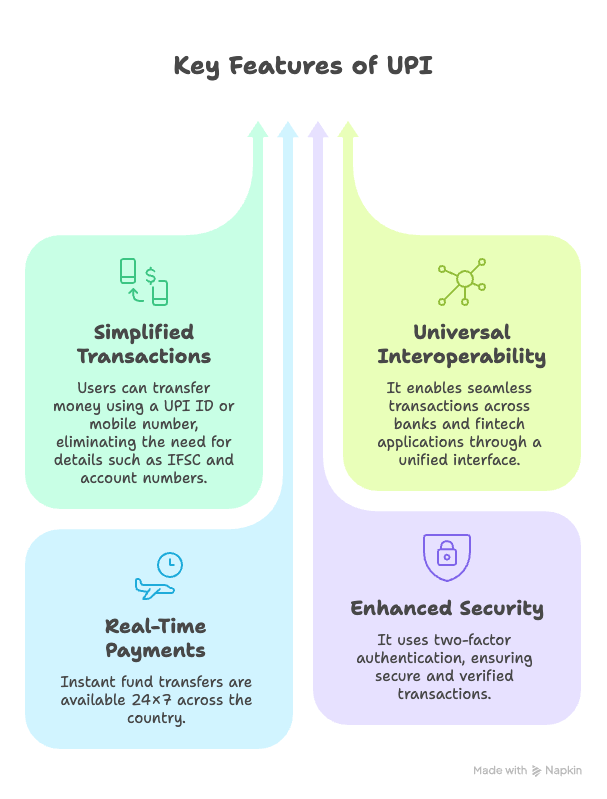
- It was launched by the National Payments Corporation of India under the regulatory oversight of the Reserve Bank of India.
- The system integrates multiple banking features into a single interoperable platform, enabling instant transactions across banks and applications.
Achievements of UPI
- Transaction Growth: Annual transactions increased from 2 crore in FY 2016–17 to 24,162 crore in FY 2025–26.
- In 2025, UPI processed around 22,000 crore transactions, with a daily average of about 60 crore transactions.
- Bank Participation: The number of banks onboarded rose from 44 to 703, covering public, private, small finance, payments, and cooperative banks.
- Global Leadership: UPI accounts for around 49% of global real-time payment transactions (2024), as recognised by the International Monetary Fund.
- UPI has been operationalised internationally, enabling cross-border payments and merchant acceptance in countries such as:
- United Arab Emirates: Widely accepted at merchant locations and used by the Indian diaspora.
- Singapore: Linked with PayNow for seamless cross-border transfers.
- France: Accepted at merchant points, especially for Indian tourists.
- Bhutan, Nepal, Sri Lanka, Mauritius, and Qatar: Integrated with local payment systems for real-time transactions.
National Payments Corporation of India
- The NPCI is an umbrella organisation for retail payments and settlement systems in India.
- It was established as an initiative of the Reserve Bank of India and the Indian Banks’ Association under the Payment and Settlement Systems Act, 2007.
- It operates as a not-for-profit company under Section 8 of the Companies Act, 2013.
- Key products include Immediate Payment Service (IMPS), National Automated Clearing House (NACH), UPI, RuPay, and Aadhaar Enabled Payment System (AePS).
Source: PIB
GalaxEye Launches Mission Drishti
Syllabus: GS3/ Science and Technology
Context
- Indian space start-up GalaxEye has launched Mission Drishti, the world’s first OptoSAR satellite, aboard SpaceX’s Falcon 9 rocket from California in the United States.
About
- Mission Drishti is an Earth observation satellite Weighing 190 kilograms.
- It is the first satellite globally to integrate Electro-Optical (EO) and Synthetic Aperture Radar (SAR) sensors into a single operational platform, enabling all-weather, day-and-night imaging capabilities.
- The satellite carries both a multispectral camera and a SAR imager for enhanced data analysis.
- Mission Drishti provides high-resolution imaging, with future satellites aiming for sub-metre resolution.
- Significance: It is a dual-use satellite, supporting both civilian and defence applications.
- Key applications include agriculture monitoring, disaster management, maritime surveillance, and infrastructure mapping.
Source: AIR
Naval Anti-Ship Missile – Short Range (NASM-SR)
Syllabus: GS3/ Defence
Context
- India successfully carried out the maiden launch of a Naval Anti-Ship Missile – Short Range (NASM-SR) from a Sea King helicopter off the Odisha coast in the Bay of Bengal.
About the Test
- Two missiles were fired in quick succession from the same platform, validating operational salvo capability.
- All test parameters were confirmed using radar, electro-optical systems, and telemetry instruments deployed at the Integrated Test Range (ITR), Chandipur.
About NASM-SR
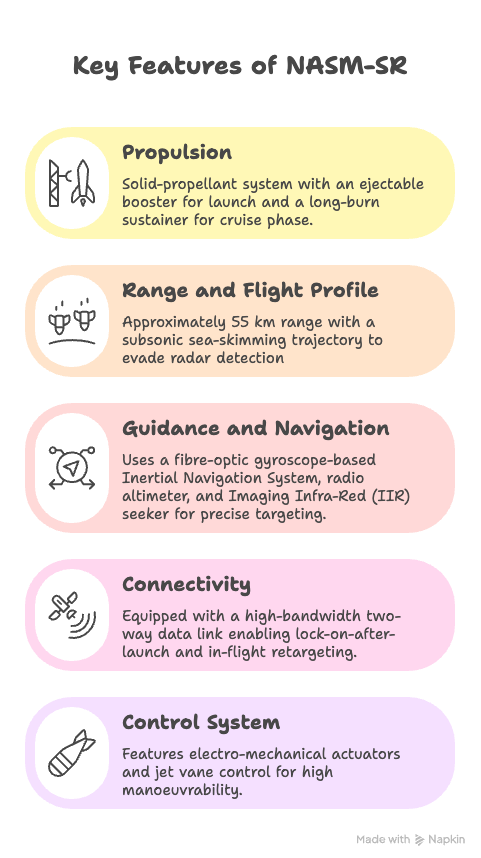
- The Naval Anti-Ship Missile – Short Range is an indigenously developed, air-launched anti-ship missile designed for helicopter-based maritime strike operations.
- It is India’s first indigenous helicopter-launched anti-ship missile, developed to replace legacy systems such as the British-origin Sea Eagle missile.
- It aimed to provide the Indian Navy with a high-precision, indigenous strike capability against maritime targets, strengthening defence self-reliance.
- The system has been developed by the Research Centre Imarat under the Defence Research and Development Organisation, in collaboration with other labs.
- All critical subsystems, including seeker, avionics, navigation, control systems, and data link, are indigenously developed.
Operational Capabilities
- Salvo Launch Capability: Ability to launch multiple missiles in rapid succession from a single platform, enhancing strike saturation in combat scenarios.
- Waterline Hit Capability: Precisely targets the ship’s hull at the waterline, maximising flooding and structural damage for effective neutralisation.
Source: TH
Use of Prosopis Juliflora
Syllabus: GS3/Environment
In News
- Prosopis juliflora is being repurposed for a bio-methanol project that converts biomass into clean fuel.
Prosopis juliflora
- Prosopis juliflora is a leguminous tree highly resistant to drought and salinity
- It is an Mexican-origin and known as gando baval in Gujarat, vilayati keekar in north India and velikathan in Tamil
- It was first introduced by the British in the 1920s to ‘green’ Delhi and by the Gujarat forest department in 1961 to halt the encroaching salt desert in the Rann.
Use for bio-methanol project
- A bio-methanol pilot project at Kandla (Deendayal) Port in Gujarat is converting the invasive shrub Prosopis juliflora into clean fuel as part of India’s green port and net-zero goals under the Harit Sagar Guidelines (2023) and Maritime India Vision 2030.
- The ₹100 crore project, set for completion by March 2027, will produce about 5 tonnes of methanol per day from biomass.
- The process involves turning biomass into syngas through gasification, then converting it into methanol using catalytic reactions.
- The fuel can be used in port operations and shipping, with potential cost advantages over synthetic alternatives like e-methanol.
Importance
- Methanol made from renewable feedstocks can cut a vessel’s CO₂ emissions by up to 95% and NOx (nitrous oxides) by up to 80% while eliminating sulphur oxides and particulate matter.
- It also supports local biomass collection, reduces environmental damage from invasive species, and promotes sustainable port development.
Source :TH
Previous article
Fire Safety Week
Next article
West Bengal Tea Workers Invoke ILO Article 24
